
Hampton Deeds and Related Instruments
Deeds in Hampton are filed with the Circuit Court Clerk, not the Real Estate Assessor. The deed is the instrument to inspect when a transfer matters. It records the conveyance, the parties, and their stated legal description. Keep its limits in mind. A deed is not a title opinion. An index search never promises that every claim or interest surfaced. Deeds of trust, releases, liens, easements, covenants, and plats share the same land-record system. They do very different jobs.
Confirm the parcel first. Use the Hampton Assessor parcel search or the city map before searching by party. For an older family or house-history question, the Hampton Virginiana and Genealogy collection offers directories, deeds, and wills. These serve as leads toward the recorded land instrument.
| Deed Type | What It Does | Common Use |
|---|---|---|
| Deed | Records a conveyance and legal description | Trace a transfer or confirm a grantee |
| Deed of trust | Records a security interest tied to a loan | Review the lien and any later release |
| Release or satisfaction | Shows a recorded release of a secured claim | Connect a debt instrument to its discharge |
| Executor or administrator deed | Conveys property through an estate fiduciary | Follow probate-related transfers |
| Lis pendens or judgment | Gives notice of a recorded legal claim | Flag a title matter for separate court review |
A deed and a deed of trust are different records. The deed handles the conveyance. The deed of trust secures an obligation. A later release can show that a recorded security interest was discharged. An assignment may move a beneficiary interest without changing the owner. Hampton also records easements, covenants, plats, lis pendens, and judgments. Read the instrument type and legal description first. Then follow any book, page, or instrument references instead of assuming every result is a sale.
Hampton Index Access and Deed Images
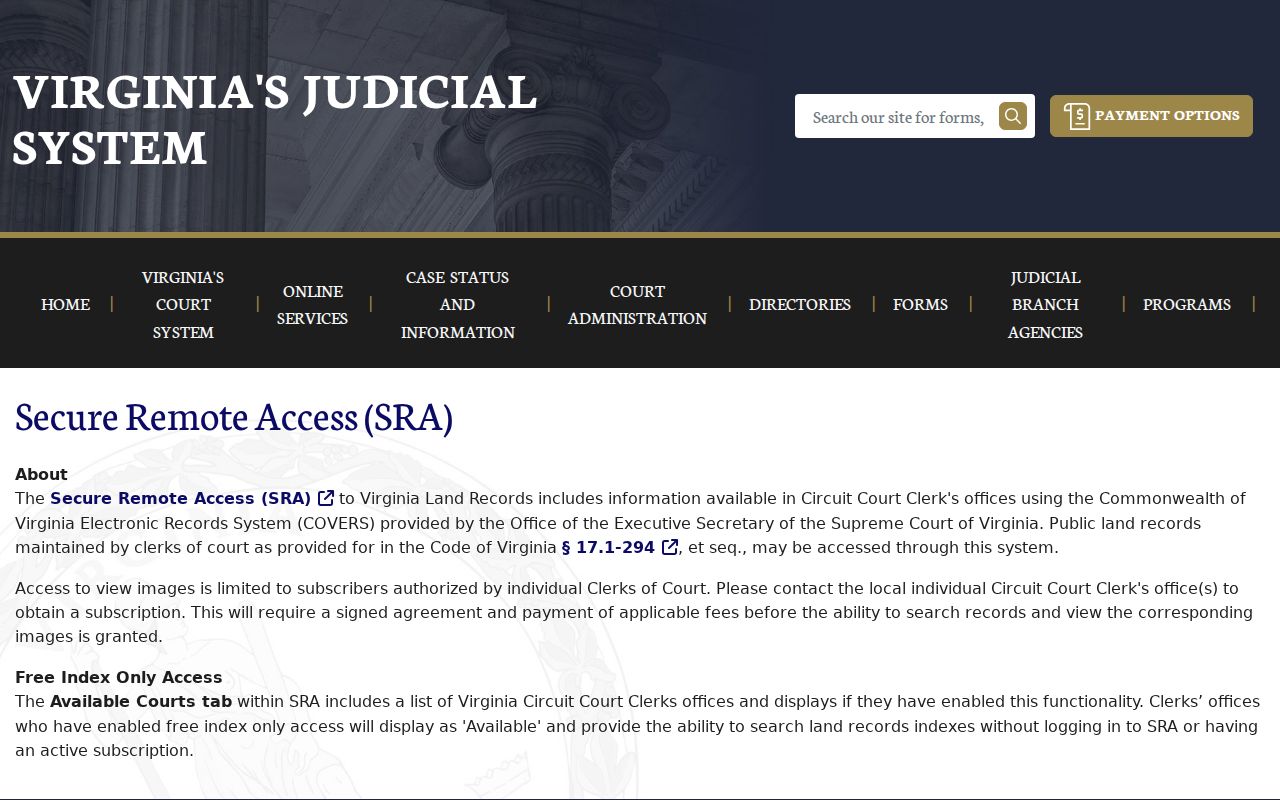
Virginia's Secure Remote Access system is the statewide route into circuit-court land-record indexes. Its Available Courts list shows where a clerk has enabled index access. An index-only search can be free. But document images require local clerk authorization, a signed subscriber agreement, and payment of applicable fees. The Hampton clerk publishes no online cutoff year, document-type dropdown, or copy-fee sheet on the public side. So do not assume the results reach back to a particular year. And do not assume every result has a public image.
The Virginia SRA access page explains the difference between index access and image access. That page matters. A free index result does not mean a deed image is open to every visitor.
Before ordering a deed image or certified copy, check current terms with the Hampton Clerk. A third-party mailer or an old fee sheet is not a reliable substitute for the office's own posted charges.
Hampton Circuit Court Land Desk
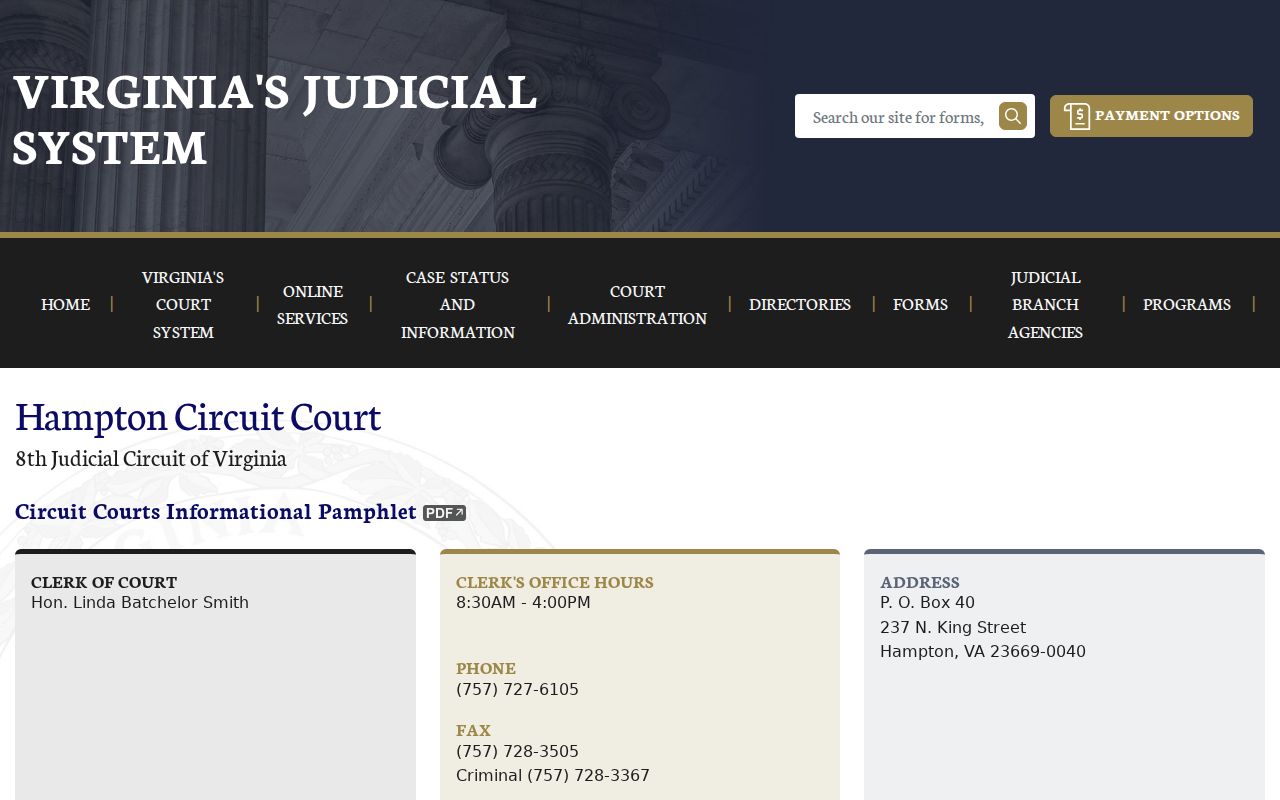
The Hampton Circuit Court Clerk keeps deeds, deeds of trust, releases, plats, judgments, liens, lis pendens, easements, covenants and wills. The land-record counter is at 237 N. King Street; the Clerk lists weekday hours of 8:30 a.m. to 4 p.m. and a 3:30 p.m. recordation cutoff. The published phone is 757-727-6105. Call ahead to ask whether a specific volume, image or archived file is available and what copy or certification charge applies. Local fees were not located in the research, so no amount should be assumed.
The Hampton Circuit Court page provides the current clerk contact and counter details. The courthouse path matters when an image is unavailable through SRA, when an older volume must be retrieved, or when an instrument reference is incomplete.
The Hampton Circuit Court page shows the clerk contact and land-record counter information.
Bring the strongest key you have, whether party names, an instrument number, book and page, a date range, or a parcel description.
Reading Hampton’s Party Index
A grantor transfers an interest. A grantee receives it. The land-record index can be searched in either role. Hampton publishes no online form with exact local field labels and coverage dates. At the counter, request a party search. Give both names, the likely roles, the instrument type, and a narrow recording date range. If a deed is already in hand, its document number or book and page can lead straight to the prior reference.
To trace earlier transfers, search the latest grantee backward as a grantor. Carry the legal description forward each time. An owner may appear under initials, a former name, a corporate name, or an estate style. An owner may instead appear under a full legal name. A hit under one spelling proves nothing about another. Where the parcel card and deed differ in timing, inspect the recorded instrument. The annual assessor roll can lag. It is not the legal chain.
- Find the newest deed for the parcel and note its grantee, grantor, recording date, document reference and legal description.
- Search the grantee as a grantor to locate the next transfer out of that owner’s name.
- Open the prior acquisition instrument and repeat, matching the land description at each step.
- Ask the Clerk whether the relevant year is online; if not, request the deed book or archival record.
- Grantor
- The party named as transferring an interest in an instrument.
- Grantee
- The party named as receiving the interest.
- Chain of title
- The sequence of recorded instruments that traces interests in the same land.
- Book and page
- A volume and page reference; a newer instrument number may identify a filing another way.
Elizabeth City County and Phoebus Deeds
Hampton grew to its present shape on July 1, 1952. That date marks the annexation and consolidation of Elizabeth City County and Phoebus. The two localities became part of the city. So older land records may carry a locality name that no longer exists. A parcel sitting inside Hampton today could appear in a deed indexed under Elizabeth City County. It might instead be indexed under Phoebus decades ago. A chain of title may seem to hit a wall at the boundary change. Search all three names before concluding anything is missing. While tracing these deeds, preserve the details that travel with them. Old street names, subdivision references and the full legal description all matter. A locality mismatch can even serve as a filing clue. It is not proof that the instrument concerns some other property. Fire is another factor in this history. The city acknowledges that blazes destroyed formal records, though the exact years and series remain uncertain. Never assert that a specific Hampton deed book burned without confirmation from the Clerk. The Library of Virginia is the other source that can confirm it. An early index entry may simply be absent. Check deed-book references, microfilm availability and the archival catalog first. Only then treat the chain as broken.
Estate Deeds in Hampton
Estate transfers rarely look like ordinary sales. The probate file names an executor or administrator. The land instrument may be indexed under the fiduciary, the estate or a beneficiary. That split trips up many searchers. Hampton Circuit Court is the local starting point for both probate files and recordable instruments. The will or qualification explains who held authority. The executor's deed, administrator's deed or deed of distribution is the document that actually moves title. A death certificate proves a death occurred. It conveys nothing. Begin with the decedent's name and an approximate date. Then determine whether the probate file is active, archived or merely indexed as an estate. Run the fiduciary and each beneficiary through the land index. Match the resulting instrument against the parcel's legal description. Some deeds name a trust or a limited liability company as the grantee. In that case, Virginia SCC entity filings help identify the entity behind the name. The recorded land instrument still stands as the evidence of the conveyance.
Hampton Deed Fraud Checks
Virginia courts launched VADeed Alert in 2026. It is a free fraud-alert service offered through participating circuit clerks. The Clerk has published no Hampton enrollment link. So confirm participation directly with the Clerk or the Virginia courts before relying on any signup page. An alert can flag a new filing. It cannot prove fraud or replace review of the recorded instrument itself. Private deed-copy mailers deserve skepticism. They may charge for a document the Clerk can supply at lower cost. The state land-record route can supply it at lower cost too. Verify the instrument number and the office's current fee before paying anything. A filing that looks suspicious should go straight to the Hampton Circuit Court Clerk. Use its published number. When a deed seems to transfer a parcel unexpectedly, compare the parties. Also compare the legal description, the recording date and any later instruments. For a true title dispute, seek legal advice.
Obtaining a Hampton Deed Copy
After the index turns up a filing, the next step depends on your access. Use SRA only if the Hampton image route is open to your account. If not, ask the Clerk about counter or written-copy options. Supply the instrument number, book and page, the parties and the recording date. Staff can then pull the right item without delay. Request a certified copy outright if that is what you need. Confirm the current charge before sending payment. Hampton posts no local copy-fee schedule. The published Clerk address includes P.O. Box 40, Hampton, VA 23669-0040; call first to verify the method and the amount.
The online index may stop short of the year you need. Deed books, microfilm or archived retrieval may still cover it. Hampton Library Special Collections holds Elizabeth City County deeds and wills. Its mail-only service suits historic context and known references. Even so, the Clerk remains the official land-record custodian. The Library cannot stand in for a certified instrument.
Recorded, not guaranteed. The Hampton index tells what was recorded and located, not whether title is clear or every interest is present. A title professional must review the full record chain.